# Velvet Business Card: The Future of Networking with RFID and NFC Technology
## Introduction to Velvet Business Cards
In today's fast-paced digital world, the traditional paper business card is undergoing a revolutionary transformation. The velvet business card represents the pinnacle of this evolution—combining luxurious tactile experience with cutting-edge RFID and NFC technology. As someone who has attended countless networking events over the past decade, I've experienced firsthand the frustration of exchanging paper cards that often get lost, forgotten, or discarded. The moment I received my first velvet-embedded NFC business card at a tech conference in Silicon Valley, I knew networking would never be the same. The smooth texture, substantial weight, and seamless digital handshake created an unforgettable impression that paper simply cannot match.
 ## How RFID and NFC Power Modern Business Cards
### Understanding the Technology Behind Smart Cards
RFID (Radio Frequency Identification) and NFC (Near Field Communication) are often used interchangeably, but they serve different purposes in business card applications. My personal experience with both technologies began when I developed a prototype for a luxury brand's client retention program. I discovered that while both use electromagnetic fields for communication, NFC is actually a subset of RFID technology with specific protocols for close-range, two-way communication.
## How RFID and NFC Power Modern Business Cards
### Understanding the Technology Behind Smart Cards
RFID (Radio Frequency Identification) and NFC (Near Field Communication) are often used interchangeably, but they serve different purposes in business card applications. My personal experience with both technologies began when I developed a prototype for a luxury brand's client retention program. I discovered that while both use electromagnetic fields for communication, NFC is actually a subset of RFID technology with specific protocols for close-range, two-way communication.
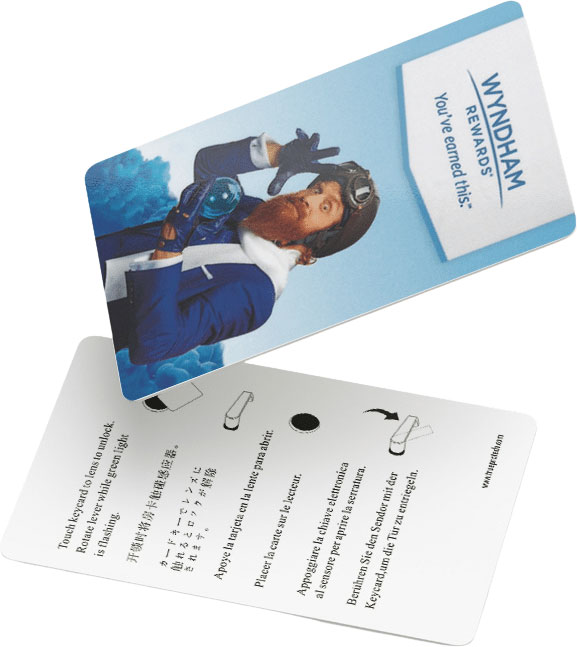 **RFID Business Cards** typically use:
- Frequency: 125 kHz or 13.56 MHz
- Read range: Up to several meters (depending on the system)
**RFID Business Cards** typically use:
- Frequency: 125 kHz or 13.56 MHz
- Read range: Up to several meters (depending on the system)
 - Storage capacity: 1KB to 8KB
- Common chips: EM4100, T5577, HID Prox
- Storage capacity: 1KB to 8KB
- Common chips: EM4100, T5577, HID Prox
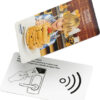
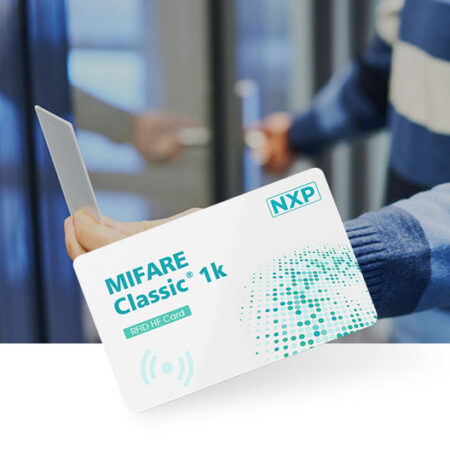 **NFC Business Cards** generally feature:
- Frequency: 13.56 MHz exclusively
- Read range: Up to 10 cm (typically 4 cm for optimal performance)
- Storage capacity: Up to 8KB (with some specialized chips offering more)
- Common chips: NTAG213, NTAG215, NTAG216, MIFARE Classic, DESFire
### Technical Specifications for Premium Velvet Business Cards
*Note: The following technical parameters are reference data. For precise specifications, please
**NFC Business Cards** generally feature:
- Frequency: 13.56 MHz exclusively
- Read range: Up to 10 cm (typically 4 cm for optimal performance)
- Storage capacity: Up to 8KB (with some specialized chips offering more)
- Common chips: NTAG213, NTAG215, NTAG216, MIFARE Classic, DESFire
### Technical Specifications for Premium Velvet Business Cards
*Note: The following technical parameters are reference data. For precise specifications, please
RFID Industry Applications
RFID technology is revolutionizing multiple sectors with its versatile applications:
- Access Control Systems
- Cashless Payment Solutions
- Inventory Management
- Asset Tracking
- Supply Chain Management
- Healthcare Patient Tracking
RFID Technical Specifications
Understanding RFID technology specifications for optimal implementation:
- Frequency: 125kHz, 13.56MHz, 860-960MHz
- Read Range: 1cm to 15m
- Memory: 64-bit to 8KB
- Standards: ISO 14443, ISO 15693
- NFC Compatibility: Type 1-4 Tags
- Durability: IP67 Water Resistance
Advanced RFID Security
Modern RFID systems incorporate multiple security layers for protection:
- 128/256-bit AES Encryption
- Anti-Cloning Protection
- Signal Shielding Technology
- Multi-Factor Authentication
- Real-Time Monitoring
- Tamper Detection Systems
RFID Future Trends
Emerging trends shaping the future of RFID technology:
- IoT Integration
- AI-Powered Analytics
- 5G Connectivity
- Energy Harvesting
- Big Data Integration
- Sustainable Materials
Ready to Implement RFID Solutions?
Whether you need access control systems, cashless payment solutions, or custom RFID implementations, our team of experts can help you navigate the latest in RFID technology.
Contact Our RFID Specialists